Diving into the Dark: My Descent into Into a Flooded Cold War Missile Silo
By Regina Carrillo
I first heard about a flooded missile silo years ago, when my husband and I were searching for “must-do” dives in Washington state. The idea of descending into a mysterious war relic instantly captured our attention. A dive unlike anything else we´d ever done.
Unfortunately, the tours shut down in 2020, and for years the silo remained locked, inaccessible, and our dream of exploring it seemed very distant.
Then, earlier this year, everything changed. The dive center reopened the expedition and we reserved our spots immediately. After nearly every weekend spent diving in our drysuits for three months, our skills felt very sharp. It was time.
Into the Past
We left home at five in the morning and met our group at a closed-down grocery store near Royal City, next to the Columbia River. A strange, quiet place to begin an adventure.
From there, we caravanned behind our guides, driving past a junkyard of rusty machinery, decaying trucks, and forgotten metal. It felt like entering a post-apocalyptic movie set.
When we reached the complex, there wasn’t much to see: a wooden shack and a stretch of fenced land. Yet underneath this lot laid a massive Cold War secret. Between the shack and the seemingly empty ground, it was hard to believe this place once housed a weapon powerful enough to alter world history.
Gearing Up for the Descent
There were fifteen of us: me, my husband, eleven other divers, and three guides from Undersea Adventures.
The guides set up folding tables, chairs and snacks. The concept was simple: gear up on land, then transport everything extra down to the silo via a pulley system. The guides had it down to a science. I put my fins, lamps, mask, computer, gloves, hood and lead into a bucket, and prepared my tank with BCD and regulators. They lowered it all for us.
The Silo
The entrance smelled like a damp cave. Cold metal, stale air, graffiti from trespassing teenagers. Not welcoming, not beautiful, but undeniably alive with mystery.
We wore drysuits and undergarments because the water hovers around 54 degrees Fahrenheit. We used Nitrox to be more conservative and stretch our no-decompression limits. The dive was deep, dark, and cold. Preparedness was everything.
We stepped single-file into the tunnel, communicating with shouts and taps, stepping over pipes and metal platforms. The water started at our chests and my BCD was fully inflated, helping me stay upright as we navigated the narrow walkway.
It felt like boarding an expedition in a movie. A mix of Star Wars: Rise of the Resistance and a sci-fi thriller, except this was real and we were the cast.
When I shined my 4200-lumen dive lamp, the water glowed crystal clear. The tunnel lit up like an industrial cathedral.
From the platform, we double checked our gear and then launched into the silo.
We began our controlled descent, stopping every ten to fifteen feet. Each time we stopped, my husband and I exchanged hand signs: “OK?” “Continue?” “Wait!” “OK!” “Let’s go!”
Everything slowed down. My senses sharpened.
Twenty feet, thirty feet, fifty feet, seventy feet… The deeper we went, the stranger the sensations. Freshwater buoyancy control felt unfamiliar. Even after removing four pounds of lead from my normal setup, I still sank faster than I expected and had to perform extra adjustments to my BCD and drysuit in order to maintain control.
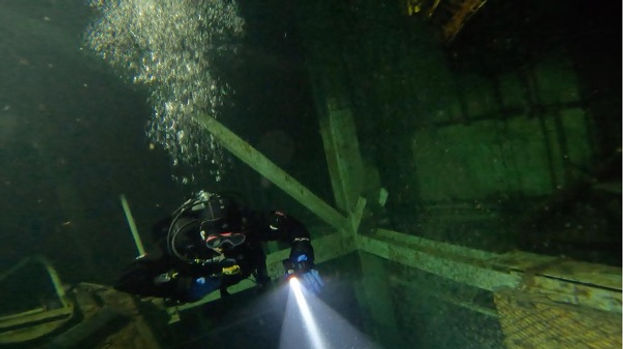
Below us, metal structures appeared out of the dark: a tall elevator shaft, gigantic steel I-beams, ladders, platforms… remnants of a world engineered for missiles, not divers.
The Depth That Tested Me
At around eighty feet, I felt it, the familiar but unsettling rush of narcosis. My heart suddenly raced as if I just started sprinting except I wasn’t moving, I wasn’t sweating, and I was floating in silence.
In a cold, dark place, that feeling can turn dangerous quickly. You can’t panic. You can’t ascend too fast. You can’t lose control.
I paused. Breathed. Ascended a few feet. Waited for my body to adapt.
The world steadied again.
At eighty five feet, I hovered in the center of the silo and looked up, staring at the vast cylinder around me. This place once held a weapon; now it holds only water, rust, memories, and the glow of dive lamps searching through the dark.
The Exploration
Our first dive lasted thirty minutes. After a quick surface interval, we continued with a short, less deep nine-minute dive into a nearby equipment room. Oddly, this one felt sketchier. The space was narrow and small. At the bottom, a copper pipe caught on my husband’s regulator. Not life-threatening, but something we needed to stop and solve. He switched to his second stage, swam clear, and switched back.
We surfaced for a barbecue the guides had prepared. We traded stories with the other divers, laughed and prepared for our final thirty-five-minute descent.
The second dive had stronger currents created by our group’s bubbles spiraling like a whirlpool. At eighty feet, my husband signaled that he wasn’t comfortable and asked to stop descending. A moment of role reversal. Usually it’s me who stops first.
We adjusted, stayed together, and found our rhythm again.
We even found some of the objects the guides had hidden for fun: a plastic skeleton, a toy shark.
For a moment I turned off my light. Other divers’ lamps illuminated the silo walls with soft glows. The darkness felt different then. Less threatening, more sacred.
Emerging into the Light
Ascending was my favorite part. The world expanded again, revealing details I had missed on the way down. Metal beams. Rusted bolts. The movement of other divers rising like slow astronauts.
After our last safety stop we surfaced into the entrance.
“Yes!” I shouted. “We did it!”
I felt accomplished, steady, and proud. Like one of those famous explorers you see in documentaries.
What the Silo Taught Me
Diving in the Caribbean was where I learned to love the ocean. But diving in the Pacific Northwest is where I have learned to trust myself.
Transitioning to drysuits, cold water, and deep, dark dives has been challenging. This silo dive was proof that I’ve grown. That I can stay calm in unexpected places. That the unknown doesn’t always have to be frightening. Sometimes it’s exactly where you find your strength.
Living in Seattle has transformed me in ways I didn’t expect. The water, the mountains, the art community, they are all shaping me into the person I want to become.
And maybe that’s why this dive mattered so much.
Because descending into darkness taught me something simple and powerful: you can trust yourself, even in the places you never thought you would be.
Sometimes especially there.